
What They Truly Seek
"The inside is larger than the outside" (224).
C. S. Lewis's The Last Battle (1956)
Points for Reflection
The Last Battle (1956)
- What evidence does Lewis provide to paint, unequivocally, Shift’s nefarious nature?
- The ape Shift evinces a mercurial, elastic mind, one adept at quickly adjusting to unexpected situations. Does Lewis implicitly applaud or critique Shift’s machinations in the opening chapter?
- Shift claims that a donkey couldn’t possibly interpret signs and portents accurately (13-14). What of a centaur? Should the reader immediately accept the validity of Roonwit’s conclusion that—based on what he sees in the stars—Aslan has not really landed in Narnia (18-19)?
- The concept of sin is sometimes linked to measurable actions including worship of drunkenness, idols, fits of rage, and sexual immorality (Galatians 5:19-21). Other times, it is tied to less tangible, more internal sins like lust, greed, and “evil desires” (Colossians 3:5-6). The writer of James, however, goes still further and asserts that “So whoever knows the right thing to do and fails to do it, for him it is sin” (4:17). With these markers in mind, consider the behavior of Puzzle. Does he commit identifiable sins in this tale?
- What of King Tirian? Is he virtue incarnate, or does he err in any egregious ways?
- The narrator himself seems uncertain as to whether King Tirian’s initial encounter with the heroes from our world happens in the midst of a dream or not. The other possibilities, of course, involve those placed before us when St. Paul describes his own supernatural encounter (2 Corinthians 12:1-10). Do you think Tirian is dreaming, having a waking vision, or that he has been bodily transported to another realm? Does it matter which actually happened?
- Does Shift’s and the others’ stratagem with Puzzle and the lion’s skin slowly feed or starve the speaking animals’ desire to know and be known by Aslan?
- How much physical and psychological suffering does this last tale contain compared with the other Narnia books you have read?
- Does Lewis capture the horrifying, discomfiting nature of extreme violence, or work to soften its impact for his young audience? Does violence ever seem absolutely necessary?
- What effect does Lewis create by his rendering of Tash? Is this god gruesome and grotesque? Does he seem in any way equivalent to Aslan?
- Can belief in and worship of Tash be redeemed in any way?
- This last book in the series sets two different nations against one another. In doing so, does it implicitly question or support the racism that often accompanies ardent nationalism? Does the book itself, that is, join forces with the dwarf who hostilely calls Calormenes “Darkies” (158)?
- Are the dwarfs led by Griffle constitutionally incapable of seeing the deeper layers of reality recognized by others, or are they wilfully blind?
- Is death an intrinsic evil in this tale?
- Why is it that Emeth is redeemed, given his lifelong devotion to another divine ruler besides Aslan?
- What features of the chapter on heaven from The Problem of Pain appear in the close of this tale?
- Where is Susan, in all this, and why? What is Lewis suggesting?
- When questioned about the allegorical nature of the Narnia books, Lewis maintained that his stories were not intended to be one-to-one, fictional representations of Biblical ideas. That said, did you catch any references to Christianity in this story even more direct than the ones we’ve seen in the earlier books?
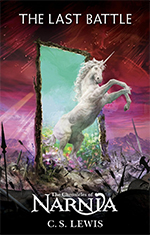
Cover Illustration to The Last Battle
Dr. Paul Marchbanks
pmarchba@calpoly.edu